
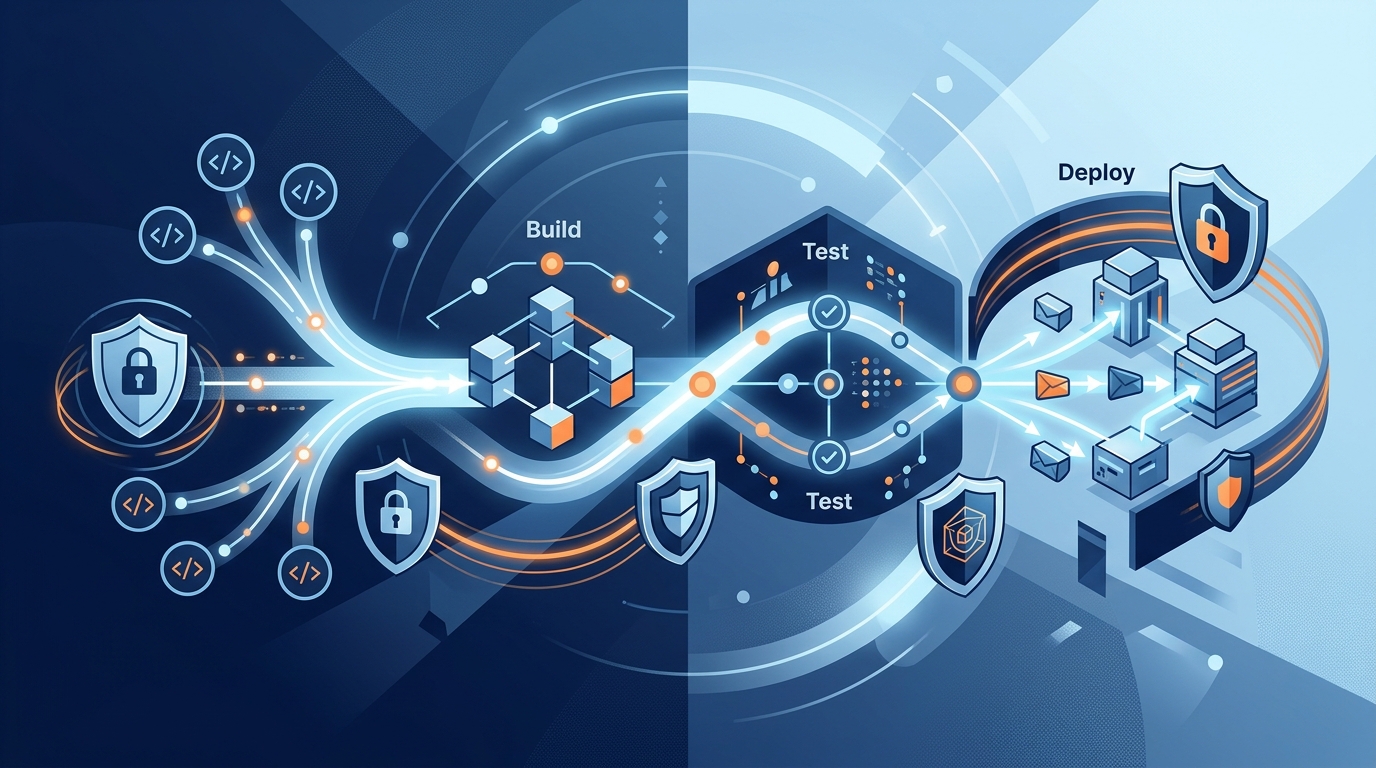
The structural tension between accelerating feature delivery and maintaining a secure, resilient production environment is a constant challenge for platform architects and engineering leaders. Daily security advisories from organizations like the Cybersecurity and Infrastructure Security Agency (CISA) and platform updates from major ecosystem providers highlight a stark reality: vulnerability management can no longer be a reactive, manual ticketing exercise. It must be an integrated, automated component of continuous delivery pipelines.
When CISA publishes a cybersecurity advisory or Google updates its developer platforms with new security requirements, the clock starts ticking. Attackers rapidly analyze these disclosures to construct working exploits, often within hours. If an organization relies on manual triage, quarterly vulnerability scans, or ad-hoc patching cycles, it operates outside the window of safety.
I have developed an architectural framework for operationalizing real-time vulnerability remediation and platform hardening. This analysis examines how to ingest threat intelligence directly into platform workflows, automate the evaluation of exploitability, secure application boundaries against emerging attack vectors, and build a resilient pipeline that balances rapid patching with system stability. The goal is to provide a concrete, technically rigorous blueprint to transform security from an external audit checkpoint into an active, automated platform capability.
The Modern Threat Landscape: Decoding Advisories for Platform Engineers
To build an effective defense, we must first understand how to interpret and operationalize modern security advisories. Generic vulnerability management programs often treat all Common Vulnerabilities and Exposures (CVEs) with a High or Critical Common Vulnerability Scoring System (CVSS) score as equally urgent. This approach is fundamentally flawed and leads to alert fatigue, friction between security and engineering teams, and delayed remediation of truly critical issues.
I recommend moving away from raw CVSS scores as the primary prioritization metric. Instead, your vulnerability response engine should synthesize three distinct data streams:
- The CISA Known Exploited Vulnerabilities (KEV) Catalog: This is the single most important source of threat intelligence for prioritization. If a vulnerability is on the KEV list, there is documented, active exploitation of this vulnerability in the wild. Regardless of whether the CVSS score is a 7.2 or a 9.8, a KEV-listed vulnerability in your environment demands immediate, out-of-band remediation.
- The Exploit Prediction Scoring System (EPSS): Maintained by FIRST, EPSS estimates the probability that a vulnerability will be exploited in the next 30 days. By combining EPSS with CVSS, you can differentiate between a theoretical vulnerability and one that is highly likely to be weaponized against your public-facing infrastructure.
- Internal Asset Context: A critical vulnerability in an isolated, non-production sandbox environment requires a different response than a medium vulnerability in an internet-facing payment gateway. Your asset inventory (CMDB) must map software dependencies to runtime environments and data classification levels.
When an advisory is published, your systems should automatically correlate the affected software components with your active software bill of materials (SBOM) and runtime container registries. This requires a centralized, queryable database of your entire software supply chain.
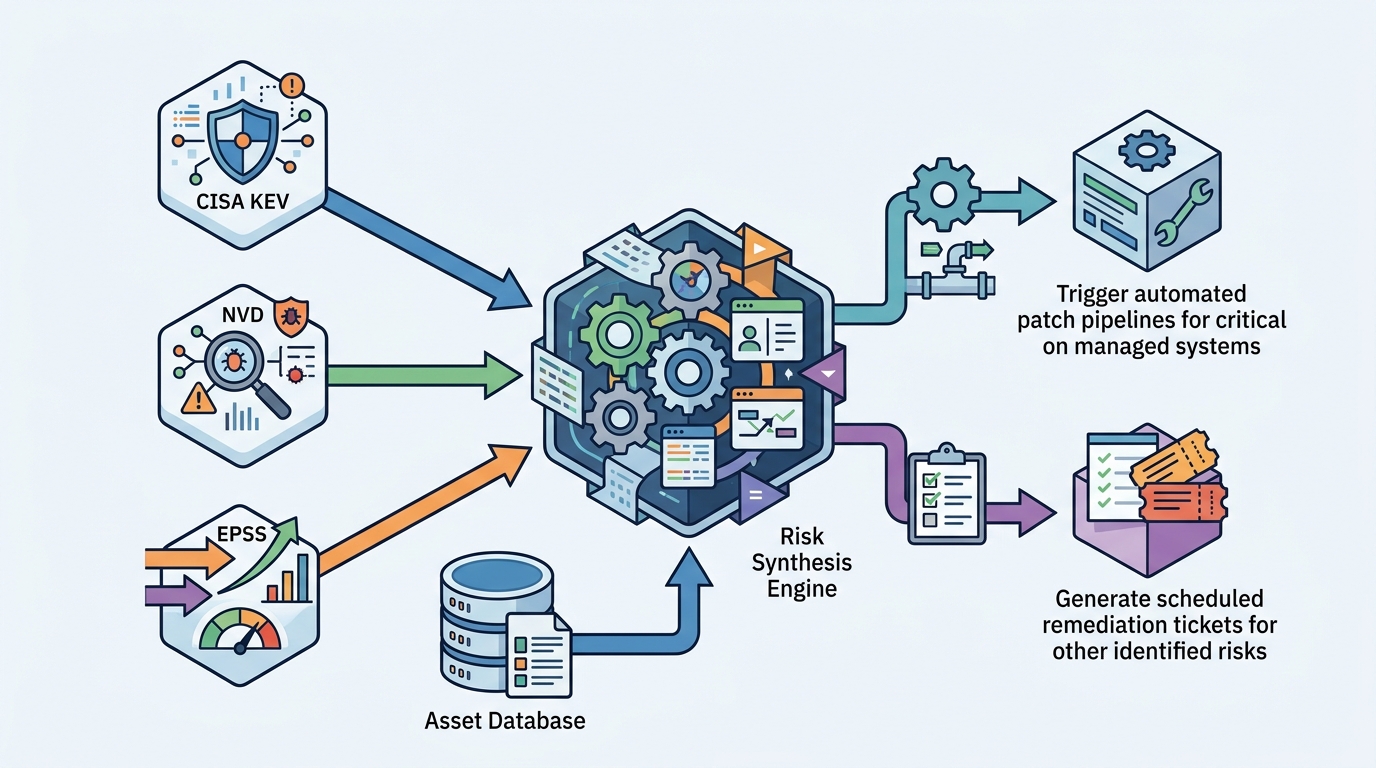
By automating this correlation, the manual triage phase is eliminated. When a new CISA advisory is released, your platform should immediately identify which running containers, virtual machines, or serverless functions are vulnerable, calculate their exposure vector, and assign a dynamic risk score that reflects actual operational danger.
Securing the Application Boundary: API and Platform Hardening
While infrastructure-level patching is critical, many modern exploits bypass network perimeters entirely by targeting application-level vulnerabilities, broken object-level authorization, or weak platform integrations. Securing the application boundary requires a defense-in-depth strategy that leverages modern browser security APIs, strict identity federation, and robust transport-layer security.
Modern Web Security Headers and Browser Sandbox Controls
If you are running web applications, your first line of defense against cross-site scripting (XSS), data injection, and clickjacking is the strict enforcement of modern browser security policies. I highly recommend auditing your application delivery controllers, API gateways, or reverse proxies to ensure the following headers are dynamically injected and strictly configured:
- Content Security Policy (CSP): Do not rely on permissive, domain-based CSPs, which are easily bypassed. Instead, implement a strict, nonce-based or hash-based CSP. This ensures that only explicitly authorized scripts can execute within the user's browser session.
- Cross-Origin Embedder Policy (COEP) and Cross-Origin Opener Policy (COOP): These headers are essential for mitigating side-channel attacks like Spectre. By isolating your origin's execution context, you prevent malicious cross-origin scripts from reading your application's memory space.
- Permissions-Policy: Explicitly restrict browser features that your application does not require. For example, disable access to the camera, microphone, geolocation, and USB APIs. This limits the blast radius if an attacker successfully injects malicious JavaScript into your frontend.
Hardening API Gateways and Identity Providers
Your API gateway is the gatekeeper of your microservices architecture. It must do more than route traffic; it must actively validate incoming requests and enforce strict security boundaries.
First, transition from long-lived API keys to short-lived, cryptographically signed JSON Web Tokens (JWTs) issued by a centralized Identity Provider (IdP) using OpenID Connect (OIDC). Your API gateway must validate these tokens at the edge, checking the signature, expiration, issuer, and audience claims before forwarding the request to downstream services.
Second, implement strict rate limiting and traffic shaping. Attackers frequently use automated tools to probe APIs for vulnerabilities, perform credential stuffing, or scrape sensitive data. I recommend implementing token-bucket or leaky-bucket rate limiting algorithms at the gateway level, configured per authenticated user identifier or, as a fallback, per source IP address.
Finally, enforce strict payload validation. Your API gateway should validate all incoming request bodies against a pre-defined OpenAPI or gRPC schema. Any request containing unexpected fields, malformed JSON, or SQL/NoSQL injection patterns must be rejected at the edge, preventing the payload from ever reaching your internal business logic.
Implementing Automated Advisory Ingestion and Policy-Based Alerting
To transition from theory to practice, we must build the tooling that automates threat intelligence ingestion. Below is a production-ready Python script designed to run as a scheduled serverless function (such as AWS Lambda or Google Cloud Function) or a cron job within your Kubernetes cluster.
This script programmatically queries the CISA Known Exploited Vulnerabilities (KEV) catalog, filters the vulnerabilities against a list of technologies used in your tech stack, correlates them with current EPSS scores, and generates structured alerts. This automation ensures that your security operations team is notified immediately when an active, in-the-wild exploit targets your specific infrastructure components.
import json
import urllib.request
import urllib.error
import logging

# Configure logging for structured output, suitable for ingestion by SIEM/Loki
logging.basicConfig(level=logging.INFO, format='%(asctime)s - %(levelname)s - %(message)s')
logger = logging.getLogger("vuln_ingestion")

CISA_KEV_URL = "https://www.cisa.gov/sites/default/files/feeds/known_exploited_vulnerabilities.json"
EPSS_API_URL = "https://api.first.org/data/v1/epss?cve="

# Define your organization's core technology stack keywords for filtering
TARGET_TECH_STACK = {"kubernetes", "nginx", "postgres", "redis", "spring_framework", "openssl", "apache"}

def fetch_json_data(url: str) -> dict:
    """Utility function to fetch and decode JSON data from a remote endpoint."""
    try:
        req = urllib.request.Request(
            url,
            headers={'User-Agent': 'Enterprise-Vuln-Scanner/1.0 (Security Operations)'}
        )
        with urllib.request.urlopen(req, timeout=15) as response:
            if response.status == 200:
                return json.loads(response.read().decode('utf-8'))
            else:
                logger.error(f"Failed to fetch data from {url}. Status code: {response.status}")
                return {}
    except urllib.error.URLError as e:
        logger.error(f"Network error while accessing {url}: {str(e)}")
        return {}
    except json.JSONDecodeError as e:
        logger.error(f"Failed to parse JSON response from {url}: {str(e)}")
        return {}

def get_epss_score(cve_id: str) -> float:
    """Fetches the EPSS score for a specific CVE from the FIRST API."""
    url = f"{EPSS_API_URL}{cve_id}"
    data = fetch_json_data(url)
    try:
        if data and "data" in data and len(data["data"]) > 0:
            # Extract the EPSS score (represented as a string decimal between 0 and 1)
            epss_str = data["data"][0].get("epss", "0.0")
            return float(epss_str)
    except (KeyError, ValueError, IndexError) as e:
        logger.warning(f"Could not parse EPSS score for {cve_id}: {str(e)}")
    return 0.0

def process_vulnerabilities():
    """Main execution logic to ingest, filter, and enrich vulnerability data."""
    logger.info("Starting CISA KEV catalog ingestion run...")
    kev_data = fetch_json_data(CISA_KEV_URL)

    if not kev_data or "vulnerabilities" not in kev_data:
        logger.critical("Unable to process CISA KEV data. Exiting process.")
        return

    matched_vulnerabilities = []

    for vuln in kev_data["vulnerabilities"]:
        cve_id = vuln.get("cveID")
        product = vuln.get("product", "").lower()
        vendor = vuln.get("vendor", "").lower()
        short_description = vuln.get("shortDescription", "")

        # Determine if the vulnerability matches any component in our tech stack
        is_match = any(
            tech in product or tech in vendor or tech in short_description.lower()
            for tech in TARGET_TECH_STACK
        )

        if is_match:
            logger.info(f"Match found in KEV: {cve_id} affecting {vendor}/{product}")
            # Enrich the KEV data with real-time EPSS probability data
            epss_score = get_epss_score(cve_id)

            enriched_vuln = {
                "cve_id": cve_id,
                "vendor": vendor,
                "product": product,
                "date_added": vuln.get("dateAdded"),
                "vulnerability_name": vuln.get("vulnerabilityName"),
                "epss_probability": epss_score,
                "remediation_action": vuln.get("requiredAction"),
                "priority_level": "CRITICAL" if epss_score > 0.1 else "HIGH"
            }
            matched_vulnerabilities.append(enriched_vuln)

    # Output the results for downstream automation consumption
    if matched_vulnerabilities:
        logger.warning(f"Identified {len(matched_vulnerabilities)} actionable vulnerabilities.")
        # In a real-world deployment, replace this print with a webhook call to Jira,
        # PagerDuty, or your SIEM ingestion pipeline.
        print(json.dumps(matched_vulnerabilities, indent=2))
    else:
        logger.info("Ingestion run complete. No matches found for current tech stack.")

if __name__ == "__main__":
    process_vulnerabilities()
This script serves as a foundational block. By integrating it into your deployment orchestration, you can automatically block builds in your CI/CD pipeline if a dependency matches a newly added KEV entry with an EPSS score above your organization's risk tolerance threshold.
Balancing Velocity and Security: Operational Trade-offs
Implementing aggressive, automated security controls inevitably introduces operational friction. As engineering leaders, we must carefully manage the trade-offs between security posture, system availability, and developer velocity.
The Risk of Automated Patching
In a perfect world, every patch is applied automatically the moment it is released. In reality, automated patching can introduce breaking changes, API regressions, and dependency conflicts that cause production outages. To mitigate this risk, I recommend implementing a tiered patching strategy based on environment classification:
- Tier 1: Non-Production Environments (Dev/QA/Staging): Apply patches automatically within 24 hours of release. This serves as your integration testing ground. If automated integration, end-to-end, and performance tests pass without regression, the patch is cleared for promotion.
- Tier 2: Canary Production Deployments: Deploy the patch to a small, isolated subset of production traffic (e.g., 5% of users) using progressive delivery tools like Argo Rollouts or Istio. Monitor key performance indicators (KPIs), error rates, and latency metrics. If any anomalies are detected, automatically roll back the deployment.
- Tier 3: Full Production Rollout: Once the canary deployment has proven stable over a defined soak period (typically 4 to 12 hours), gradually promote the patch to the entire production fleet.
Managing Developer Friction
If security tooling is slow, noisy, or constantly blocks deployments with false positives, developers will find ways to bypass or disable it. To prevent this, your security integration must be seamless and developer-centric.
- Shift Left, but Keep it Fast: Integrate vulnerability scanning directly into the developer's local environment (using IDE plugins) and pre-commit hooks. However, ensure that local scans execute in seconds, not minutes. Save deep, time-consuming static application security testing (SAST) and software composition analysis (SCA) runs for the asynchronous CI pipeline.
- Provide Actionable Remediation Paths: Do not simply tell a developer that a dependency is vulnerable. Your tooling should automatically generate a pull request that upgrades the dependency to the minimum safe version, verifying that the build still succeeds.
- Establish a Clear Exception Process: There will be times when a patch cannot be applied immediately due to business-critical constraints. Establish a transparent, audit-logged process within your GitOps repository where senior engineers can temporarily bypass a security block by documenting a compensating control (e.g., a Web Application Firewall rule) and setting a strict expiration date for the exception.
| Operational Dimension | Reactive Approach (Traditional) | Proactive Approach (Modern Platform) |
|---|---|---|
| Vulnerability Discovery | Scheduled quarterly scans | Continuous, event-driven SBOM analysis |
| Prioritization Metric | Raw CVSS scores | KEV status + EPSS probability + Asset context |
| Remediation SLA | 30 to 90 days (often missed) | Automated canary patching within 24-72 hours |
| Developer Experience | PDF reports sent via email | Automated PRs with dependency upgrades |
| Production Risk | High risk of manual patching errors | Low risk via progressive delivery and automated rollbacks |
Conclusion
Modern vulnerability management is not a static compliance checkbox; it is a dynamic engineering discipline. By shifting from reactive, manual patching to an automated, threat-informed response pipeline, we can protect our organizations from active exploits without sacrificing developer velocity.
To operationalize this approach within your engineering organization, I recommend taking the following immediate steps:
- Audit your current vulnerability response times: Measure the mean time to detect (MTTD) and mean time to remediate (MTTR) for a critical vulnerability in your production environment. Use this data as your baseline.
- Implement continuous SBOM generation: Integrate tools like Syft or Trivy into your build pipelines to generate cryptographically signed Software Bills of Materials for every container image you build.
- Automate threat intelligence ingestion: Deploy the CISA KEV and EPSS ingestion script provided in this article to automatically flag high-risk vulnerabilities targeting your specific technology stack.
- Adopt progressive delivery for security updates: Work with your platform engineering team to integrate canary deployments and automated rollbacks into your patching workflows, ensuring that security updates never compromise system availability.
By building these capabilities directly into your platform architecture, you ensure that your systems remain resilient, compliant, and secure-by-design in the face of an ever-evolving threat landscape.