
Introduction
As engineering leaders, we are constantly caught in a structural crossfire. On one side, product roadmaps demand rapid feature delivery, modern API integrations, and seamless user experiences. On the other, an increasingly sophisticated threat landscape demands absolute vigilance, zero-trust architectures, and immediate mitigation of newly discovered vulnerabilities. Balancing these competing forces is not a one-time project; it is an ongoing operational discipline.
In my work analyzing systemic infrastructure failures and software supply chain compromises, I have observed that the most devastating breaches rarely stem from highly exotic zero-day exploits. Instead, they occur because of known vulnerabilities left unpatched, misconfigured cloud environments, or insecure defaults in application development frameworks. Recent advisories from the Cybersecurity and Infrastructure Security Agency (CISA) and updates from Google’s developer ecosystems underscore a critical reality: security cannot be treated as an external audit layer. It must be baked directly into our daily development workflows and operational pipelines.
This briefing translates recent security advisories and modern developer guidance into a concrete, actionable framework for engineering leaders. I will analyze how to operationalize threat intelligence, establish secure-by-default application architectures, secure your software supply chain, and implement a rigorous operational audit to protect your systems without stalling your engineering velocity.
1. Operationalizing Threat Intelligence: Beyond the CVSS Score
For years, engineering teams have relied almost exclusively on Common Vulnerability Scoring System (CVSS) scores to prioritize security patches. In my view, this approach is fundamentally broken. A CVSS score measures theoretical severity, not actual risk. If a vulnerability has a CVSS score of 9.8 but requires a highly specific, rare configuration that does not exist in your environment—and has never been observed being exploited in the wild—treating it as an immediate blocker is an inefficient use of engineering resources. Conversely, a CVSS 7.5 vulnerability that is actively being exploited by ransomware groups demands your immediate attention.
To build a rational, high-velocity patching cycle, I recommend shifting your focus to active threat intelligence, specifically leveraging CISA’s Known Exploited Vulnerabilities (KEV) catalog and the Exploit Prediction Scoring System (EPSS). The KEV catalog is a curated list of vulnerabilities that have been validated as actively exploited in the wild. If a vulnerability appears on this list, the debate over whether to patch it is over; you must remediate it immediately.
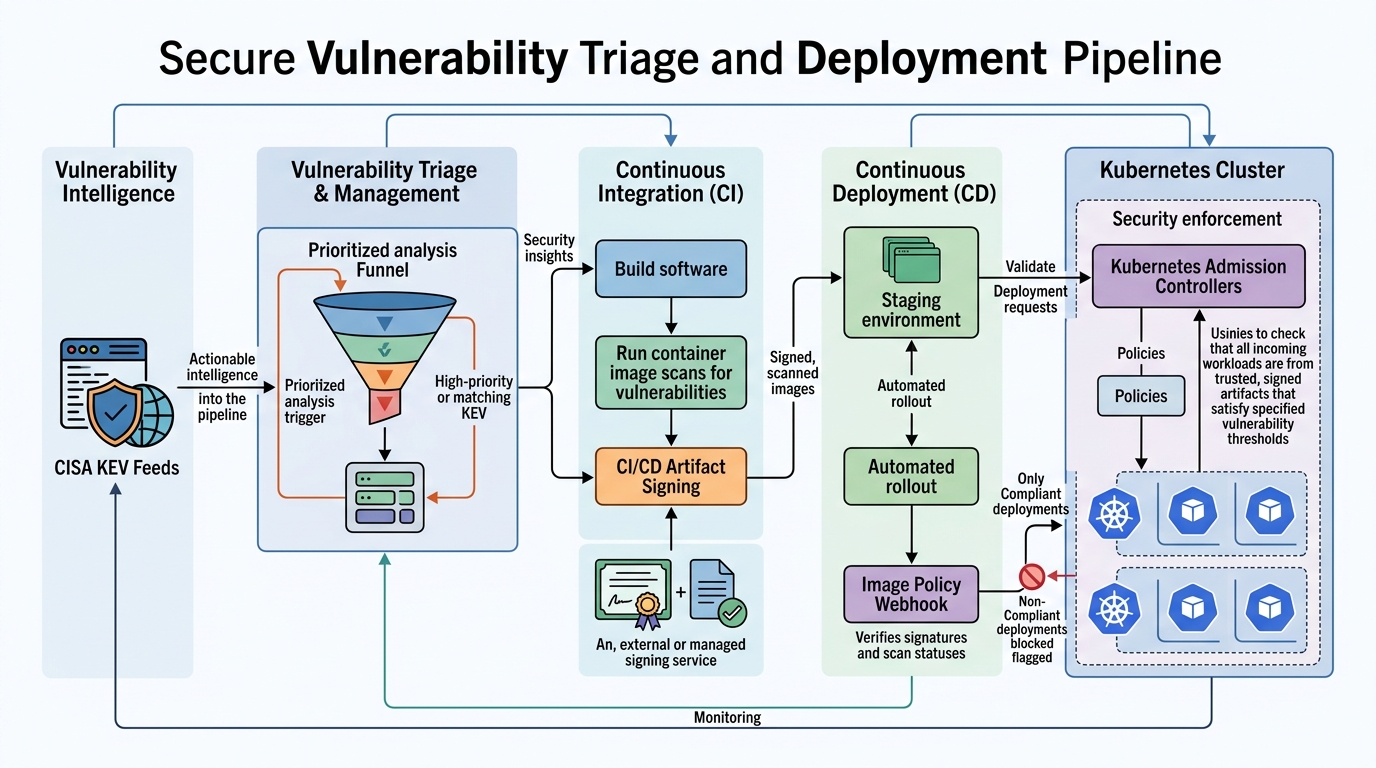
To operationalize this, your vulnerability management tools should programmatically cross-reference your software bill of materials (SBOM) and container scan results with the live KISA KEV feed. Rather than waiting for monthly security reviews, your triage pipeline should trigger automated alerts when an active exploit vector matches a package in your production environment.
Below, I have provided a practical Python script designed to run within a CI/CD pipeline or as a scheduled cron job. This script fetches the live CISA KEV database, compares it against a local list of detected vulnerabilities in your environment, and outputs an actionable remediation payload. It demonstrates how to programmatically bypass CVSS noise and isolate active threats.
import json
import urllib.request
import sys

CISA_KEV_URL = "https://www.cisa.gov/sites/default/files/feeds/known_exploited_vulnerabilities.json"

def fetch_cisa_kev():
    try:
        with urllib.request.urlopen(CISA_KEV_URL, timeout=10) as response:
            if response.status == 200:
                return json.loads(response.read().decode('utf-8'))
    except Exception as e:
        print(f"[ERROR] Failed to fetch CISA KEV feed: {e}", file=sys.stderr)
        sys.exit(1)

def analyze_vulnerabilities(local_cves):
    kev_data = fetch_cisa_kev()
    catalog_version = kev_data.get("catalogVersion", "Unknown")
    date_released = kev_data.get("dateReleased", "Unknown")

    print(f"[INFO] Loaded CISA KEV Catalog Version: {catalog_version} (Released: {date_released})")

    kev_lookup = {
        vuln["cveID"]: {
            "vendorProject": vuln.get("vendorProject"),
            "product": vuln.get("product"),
            "vulnerabilityName": vuln.get("vulnerabilityName"),
            "dateAdded": vuln.get("dateAdded"),
            "requiredAction": vuln.get("requiredAction")
        }
        for vuln in kev_data.get("vulnerabilities", [])
    }

    critical_hits = []
    for local_cve in local_cves:
        if local_cve in kev_lookup:
            critical_hits.append((local_cve, kev_lookup[local_cve]))

    return critical_hits

if __name__ == "__main__":
    # Example payload representing CVEs detected in a production container scan
    detected_cves = ["CVE-2021-44228", "CVE-2023-38606", "CVE-2024-99999"]

    hits = analyze_vulnerabilities(detected_cves)

    if hits:
        print(f"\n[ALERT] Found {len(hits)} actively exploited vulnerabilities in your environment!")
        for cve, details in hits:
            print(f"\n--> {cve} - {details['vendorProject']} {details['product']}")
            print(f"    Name: {details['vulnerabilityName']}")
            print(f"    Added to KEV: {details['dateAdded']}")
            print(f"    Required Action: {details['requiredAction']}")
        sys.exit(1)  # Fail the build or trigger alert
    else:
        print("\n[SUCCESS] No actively exploited CVEs from the CISA KEV catalog detected.")
        sys.exit(0)
By integrating this programmatic check, you transform security from a reactive, manual audit into an automated gate. If a build contains a vulnerability listed in the KEV, the build fails, or an emergency ticket is routed directly to the on-call engineering team. This prevents your engineers from wasting time chasing theoretical risks and focuses their energy on the vulnerabilities that pose a real, immediate threat to your business continuity.
2. Hardening the Application Layer: Secure Defaults and Modern API Design
Security cannot be achieved if developers must remember to apply security controls manually every time they write a new feature. In my experience, the most effective way to eliminate application-layer vulnerabilities is to adopt a "secure-by-default" philosophy. This means that the frameworks, libraries, and internal platforms you provide to your developers must be configured to be secure out of the box.
Consider modern web and API development. Google’s developer guidance consistently emphasizes the mitigation of injection attacks, cross-site scripting (XSS), and broken object-level authorization (BOLA). If your developers are manually constructing SQL queries or manually sanitizing HTML inputs, you have already lost the battle. You must mandate the use of object-relational mappers (ORMs) that parameterize queries by default and template engines that auto-escape outputs.
Furthermore, modern browser security mechanisms must be strictly enforced at the HTTP header level. A robust Content Security Policy (CSP) is one of your most powerful lines of defense against XSS and data exfiltration. Rather than relying on permissive legacy policies, I advise implementing strict, nonce-based or hash-based CSPs.
Similarly, when designing APIs, you must enforce authorization checks at the framework level. A common failure pattern is relying on developers to write authorization checks inside every individual controller or endpoint. Instead, your API gateway or routing middleware should intercept every incoming request, validate the caller’s identity (using cryptographically signed tokens like JWTs), and verify their permissions against a centralized access control policy before the request ever reaches your business logic.
Additionally, you should implement strict rate limiting and input validation schemas at the edge. Every API endpoint must have a strictly defined schema (such as OpenAPI/Swagger specs) that defines exactly what data types, lengths, and formats are acceptable. Any request that does not conform to this schema should be rejected immediately at the gateway, preventing malicious payloads from ever being processed by your internal microservices.
3. Securing the Software Supply Chain: From Commit to Production
As our applications rely increasingly on open-source packages and third-party dependencies, the software supply chain has become a primary target for malicious actors. Attackers are no longer just looking for vulnerabilities in your custom code; they are actively poisoning upstream dependencies, executing dependency confusion attacks, and compromising developer workstations to inject malicious payloads into your build pipelines.
To secure your software supply chain, you must establish a continuous chain of trust from the moment a developer commits code to the moment that code runs in production. This requires several critical operational controls.
First, you must enforce dependency pinning and lockfile verification. Simply specifying a dependency version range (e.g., ^1.2.0) in your package manifest is an unacceptable security risk. An attacker who compromises a dependency can publish a malicious minor release, which your build pipeline will automatically pull down during the next deployment. You must commit lockfiles (such as package-lock.json, poetry.lock, or go.sum) to version control and configure your CI/CD pipelines to perform clean installations that strictly respect those lockfiles.
Second, you should establish a private artifact repository (such as Sonatype Nexus, JFrog Artifactory, or AWS CodeArtifact) to act as a secure buffer between your build systems and the public internet. This repository should be configured to cache approved dependencies, scan them for vulnerabilities before they are made available to developers, and prevent dependency confusion attacks by explicitly mapping internal package scopes to your private registry.
Third, you must secure your CI/CD pipelines themselves. Build runners should be ephemeral, isolated virtual environments that are destroyed immediately after a build completes. Secrets used during the build process—such as API keys, cloud credentials, and signing certificates—must never be hardcoded or stored in environment variables within your repository configuration. Instead, use short-lived, dynamically generated credentials obtained via OpenID Connect (OIDC) from your cloud provider.
Finally, implement artifact signing and verification. By using tools like Sigstore Cosign, your build pipeline can cryptographically sign container images and build artifacts upon successful compilation. Your production environment (such as a Kubernetes cluster running an admission controller like Kyverno) should then be configured to reject any container image that does not carry a valid signature from your trusted build pipeline. This ensures that even if an attacker gains access to your container registry, they cannot run unauthorized or modified images in your production environment.
4. The Engineering Leader's Operational Audit Checklist
To ensure your organization is actively mitigating these risks, you must establish clear, measurable baselines. I have compiled the following operational audit checklist to help you evaluate your current security posture, identify critical gaps, and track your remediation progress.
| Security Domain | Legacy/Risky Approach | Modern Secure-by-Design Standard | Primary Verification Metric | Target SLA / KPI |
|---|---|---|---|---|
| Vulnerability Triage | Reacting solely to CVSS scores; manual spreadsheet tracking. | Automated integration with CISA KEV and EPSS feeds to prioritize active threats. | Percentage of KEV-listed vulnerabilities detected and patched. | < 24 hours for KEV vulnerabilities; < 14 days for high CVSS. |
| API Authorization | Authorization checks written manually inside individual controller endpoints. | Centralized middleware/API gateway validating JWTs and enforcing RBAC/ABAC. | Static analysis (SAST) coverage verifying authorization decorators are present on all endpoints. | 100% endpoint coverage; zero unauthenticated public endpoints. |
| Dependency Management | Loose version ranges in package manifests; pulling directly from public registries. | Strict lockfile enforcement; private artifact repository caching scanned packages. | Dependency vulnerability scan clean rate in CI/CD pipelines. | Zero high/critical vulnerabilities in production-bound dependencies. |
| Secrets Management | Hardcoded secrets in code; long-lived credentials stored in CI/CD variables. | Ephemeral, short-lived credentials requested dynamically via OIDC. | Automated secret scanning runs on every commit and pull request. | Zero secrets committed to version control; 100% OIDC adoption for cloud deployments. |
| Artifact Integrity | Deploying unsigned container images directly from a registry. | Cryptographic artifact signing (e.g., Cosign) verified by production admission controllers. | Percentage of running workloads with verified cryptographic signatures. | 100% of production workloads verified prior to execution. |
I recommend reviewing this checklist with your engineering leads and security champions on a quarterly basis. Use these metrics not as a stick to punish teams, but as a roadmap to justify technical debt reduction and infrastructure modernization initiatives. When you frame security as an operational quality metric, you align developers and security teams toward a shared goal: shipping resilient, high-quality software.
Conclusion
Securing modern software systems is not an objective achieved by completing a checklist; it is an ongoing operational posture. As engineering leaders, my advice to you is to move away from the outdated model of treating security as a gatekeeper that sits at the end of the development lifecycle. This model creates friction, slows down delivery, and ultimately fails to protect your systems because it relies on manual, human intervention.
Instead, you must focus your efforts on engineering systemic resilience. By operationalizing active threat intelligence like CISA's KEV catalog, you eliminate noise and focus your team's energy on real-world threats. By building secure-by-default application architectures and APIs, you protect your developers from making common mistakes. And by securing your software supply chain from commit to production, you ensure the integrity of every line of code that runs in your environment.
Your immediate next step should be to audit your current vulnerability management pipeline. Determine how much time your team spends debating CVSS scores versus patching actively exploited vulnerabilities. Implement automated KEV filtering, establish secure defaults in your core frameworks, and begin the transition to signed, verified artifacts. By taking these concrete steps, you will not only harden your systems against modern threats but also build a faster, more confident engineering organization.