

Introduction
In the modern software engineering landscape, a persistent tension exists between rapid feature delivery and rigorous security posture. Engineering teams, often guided by developer-centric methodologies, prioritize velocity, seamless user experiences, and rapid iteration. Conversely, security operations teams—informed by urgent directives such as CISA Cybersecurity Advisories—focus on threat mitigation, attack surface reduction, and vulnerability elimination. For too long, these two disciplines have operated in silos, treating security as an external audit phase or a blocking gate late in the delivery lifecycle.
I have observed that this reactive model is fundamentally broken. When security is treated as a downstream checklist, the resulting fixes are often superficial, fragile, and costly to maintain. To build resilient systems, we must bridge this gap by adopting a "Secure-by-Design" philosophy. This approach, championed by both leading technology platforms and national cybersecurity authorities, mandates that security is integrated into the foundational architecture of our software, frameworks, and deployment pipelines.
In this article, I will analyze how to operationalize Secure-by-Design principles within modern web and API architectures. I will examine how to leverage framework-level protections to eliminate entire classes of vulnerabilities, design zero-trust API boundaries that withstand credential compromise, secure the software supply chain against sophisticated injection attacks, and establish runtime observability that enables rapid incident response. My goal is to provide you with a pragmatic, technically rigorous blueprint to elevate your organization's security posture without sacrificing development velocity.
Shifting Left: Framework-Level Protections and Secure Defaults
The most effective way to secure an application is to make security the default, non-negotiable state of the system. If a developer must remember to manually sanitize input or escape output to prevent a vulnerability, the system will eventually fail. Human vigilance does not scale. Therefore, I advocate for shifting security responsibilities away from individual developer discipline and toward framework-level enforcement.
Consider Cross-Site Scripting (XSS), which has plagued web applications for decades. Historically, developers relied on manual escaping functions applied at the render layer. Modern web frameworks, such as those developed and maintained by Google, have systematically addressed this by introducing context-aware auto-escaping by default. In environments where dynamic HTML generation is absolutely necessary, relying solely on escaping is insufficient. This is where Trusted Types come into play.
Trusted Types lock down dangerous sink APIs (such as Element.innerHTML or eval) at the browser level. When Trusted Types are enabled via a Content Security Policy (CSP) header, the browser refuses to accept plain strings for these sinks. Instead, developers must pass a typed object that has been processed by a user-defined, secure policy. This effectively centralizes your sanitization logic into a few audited policies, rendering the rest of your codebase immune to DOM-based XSS.
Beyond front-end frameworks, secure defaults must be enforced at the network and transport layers. Every modern web application should deploy a robust set of security headers. These are not merely compliance checkboxes; they are active defense mechanisms:
- Content Security Policy (CSP): Restricts the origins from which scripts, stylesheets, and images can be loaded, and disables unsafe inline execution.
- Strict-Transport-Security (HSTS): Forces browsers to interact with your domain exclusively over HTTPS, mitigating man-in-the-middle attacks during initial connections.
- X-Content-Type-Options: Prevents browsers from MIME-sniffing a response away from the declared content-type, blocking malicious file upload execution.
- Cross-Origin Policies (COOP, COEP, CORP): Isolate your application's execution environment in the browser, protecting against speculative side-channel attacks like Spectre.
When I design a modern web architecture, I ensure these headers are injected at the edge—typically at the API gateway or Content Delivery Network (CDN) layer—rather than relying on individual microservices to set them. This guarantees global compliance and simplifies the architectural footprint.
Zero-Trust API Architecture and Cryptographic Identity
As organizations migrate from monolithic architectures to distributed microservices, the traditional network perimeter dissolves. Believing that traffic inside your private network is inherently safe is a critical architectural flaw. CISA’s zero-trust guidelines emphasize that every request must be authenticated, authorized, and validated, regardless of its origin.
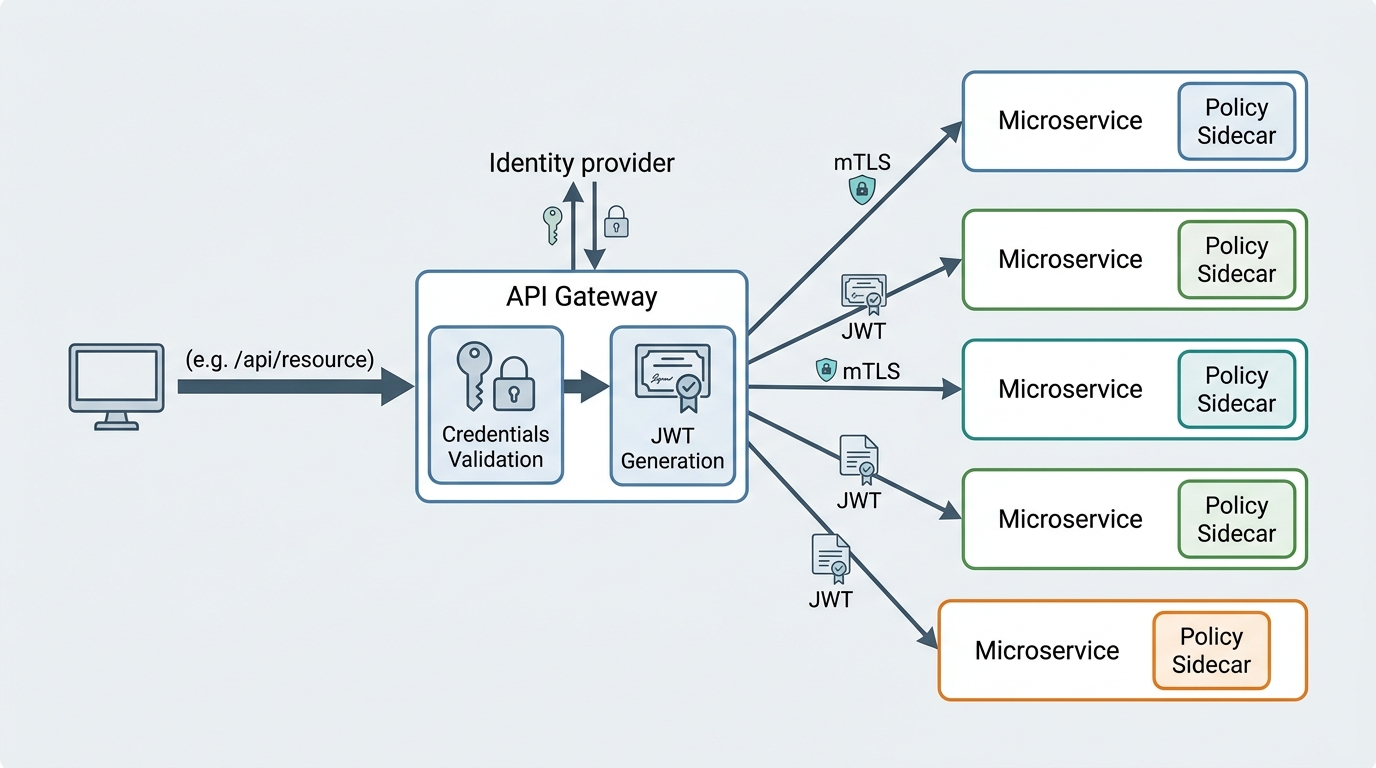
To implement this, I recommend a multi-layered identity strategy that separates client-to-gateway authentication from service-to-service authorization. At the edge, client requests should be terminated at an API gateway. The gateway validates the client's credentials—whether they are OAuth 2.1 authorization codes, API keys, or session cookies—and translates them into a short-lived, cryptographically signed token, such as a JSON Web Token (JWT).
This JWT acts as an ephemeral identity document that flows through your internal microservices. However, relying solely on JWTs can lead to the "Confused Deputy" problem, where a compromised service uses a valid user token to perform unauthorized actions on another service. To prevent this, your service-to-service communication must be secured using Mutual TLS (mTLS). mTLS ensures that every microservice has a strong, cryptographically verifiable identity (typically managed via SPIFFE/SPIRE or a service mesh like Istio) and that all inter-service traffic is encrypted and authenticated.
Furthermore, authorization must be decoupled from application code. Hardcoding role checks (e.g., if (user.hasRole('admin'))) leads to fragile, unmaintainable security policies. Instead, I advise adopting a policy-as-code engine like Open Policy Agent (OPA). OPA allows you to write declarative authorization policies that run alongside your microservices as sidecars, evaluating requests in real-time based on rich context.
Below is an example of a secure Go middleware implementation that validates an incoming JWT, extracts claims, and enforces strict, context-aware validation before allowing a request to reach your core business logic:
package middleware

import (
	"context"
	"crypto/rsa"
	"errors"
	"fmt"
	"net/http"
	"strings"

	"github.com/golang-jwt/jwt/v5"
)

type Claims struct {
	TenantID string   `json:"tid"`
	Scopes   []string `json:"scp"`
	jwt.RegisteredClaims
}

type JWTMiddleware struct {
	PublicKey *rsa.PublicKey
}

func NewJWTMiddleware(pubKey *rsa.PublicKey) *JWTMiddleware {
	return &JWTMiddleware{PublicKey: pubKey}
}

func (m *JWTMiddleware) Handler(next http.Handler) http.Handler {
	return http.HandlerFunc(func(w http.ResponseWriter, r *http.Request) {
		authHeader := r.Header.Get("Authorization")
		if authHeader == "" {
			http.Error(w, "Authorization header missing", http.StatusUnauthorized)
			return
		}

		parts := strings.Split(authHeader, " ")
		if len(parts) != 2 || strings.ToLower(parts[0]) != "bearer" {
			http.Error(w, "Invalid authorization format", http.StatusUnauthorized)
			return
		}

		tokenString := parts[1]
		claims := &Claims{}

		token, err := jwt.ParseWithClaims(tokenString, claims, func(token *jwt.Token) (interface{}, error) {
			if _, ok := token.Method.(*jwt.SigningMethodRSA); !ok {
				return nil, fmt.Errorf("unexpected signing method: %v", token.Header["alg"])
			}
			return m.PublicKey, nil
		})

		if err != nil || !token.Valid {
			http.Error(w, "Invalid or expired token", http.StatusUnauthorized)
			return
		}

		// Enforce tenant isolation and context propagation
		if claims.TenantID == "" {
			http.Error(w, "Missing tenant context", http.StatusForbidden)
			return
		}

		ctx := context.WithValue(r.Context(), "tenant_id", claims.TenantID)
		ctx = context.WithValue(ctx, "scopes", claims.Scopes)

		next.ServeHTTP(w, r.WithContext(ctx))
	})
}
This middleware ensures that every request passing into your system has a cryptographically verified tenant identity, preventing cross-tenant data leakage—one of the most severe vulnerabilities in SaaS architectures.
Threat Modeling and Vulnerability Management in the CI/CD Pipeline
Building a secure architecture is not a static event; it is a continuous process that must be integrated directly into your software development lifecycle (SDLC). CISA frequently issues alerts regarding vulnerabilities in open-source libraries and third-party dependencies. To defend against supply chain attacks, you must treat your CI/CD pipeline as a hardened security boundary.
I recommend structuring your pipeline around the Supply-chain Levels for Software Artifacts (SLSA) framework. SLSA provides a set of incrementally adoptable security guidelines that protect against tampering, unauthorized modifications, and build-time compromises.
First, you must gain complete visibility into what you are deploying. This requires generating a Software Bill of Materials (SBOM) for every build. An SBOM is a machine-readable inventory of all software components, dependencies, and metadata. By generating an SBOM at build time, you can continuously scan your active inventory against vulnerability databases (such as the National Vulnerability Database or CISA’s Known Exploited Vulnerabilities catalog) without needing to rescan the source code repository repeatedly.
Second, you must automate your testing gates. Static Application Security Testing (SAST) and Software Composition Analysis (SCA) should be executed on every pull request. However, to prevent developer fatigue, you must tune these tools to minimize false positives. I advise blocking builds only on high-confidence, high-severity findings (such as hardcoded credentials or critical, exploitable CVEs with public exploits available).
To help you evaluate your pipeline's security posture, I have compiled a checklist of critical controls that should be integrated into your delivery workflow:
| Pipeline Phase | Security Control | Objective | Implementation Mechanism |
|---|---|---|---|
| Source Control | Branch Protection & Signed Commits | Prevent unauthorized code injection and verify developer identity. | Require signed commits; enforce multi-party review for all main branch merges. |
| Dependency Management | Software Composition Analysis (SCA) | Detect known vulnerabilities in third-party libraries. | Run automated scans (e.g., Trivy, Snyk) on every dependency manifest change. |
| Build Phase | Hermetic Builds & SBOM Generation | Ensure build reproducibility and track software components. | Use isolated build environments; generate SPDX or CycloneDX SBOMs. |
| Artifact Registry | Container Image Signing | Verify the integrity and origin of deployed artifacts. | Sign images using Cosign/Sigstore; enforce verification policies at deployment. |
| Deployment | Policy-Based Admission Control | Prevent unverified or vulnerable containers from running. | Use Kubernetes admission controllers (e.g., Kyverno, OPA Gatekeeper) to block unsigned images. |
By implementing these automated controls, you establish a deterministic path to production where only verified, secure code can be executed in your environments.
Operationalizing Observability and Incident Response
Even the most secure architectures can experience anomalies or active exploitation attempts. When an incident occurs, the speed of your response is directly proportional to the quality of your observability data. However, I often see organizations struggle because their logging is either non-existent or, conversely, so verbose that it leaks sensitive data.
To build an operationally secure system, you must design your logging and telemetry with intentionality. First, establish strict guidelines regarding what cannot be logged. Personally Identifiable Information (PII), passwords, API keys, and session tokens must be scrubbed at the application level before they reach your log aggregators. I recommend using structured logging (such as JSON format) to make logs easily queryable and to facilitate automated parsing.
Second, implement distributed tracing. In a microservices architecture, a single user request might traverse dozens of services. Without a unified trace ID, debugging a security anomaly is nearly impossible. By utilizing OpenTelemetry, you can inject a unique trace context at your API gateway and propagate it across all downstream HTTP requests, gRPC calls, and message queues. This allows your security operations team to reconstruct the exact path an attacker took through your system.
Finally, your observability platform must be paired with actionable alerting. Rather than alerting on generic system metrics (like CPU usage), focus on high-fidelity indicators of compromise (IoCs) and anomalous behaviors:
- Rate Limit Exhaustion: A sudden spike in 429 (Too Many Requests) errors often indicates a brute-force or credential-stuffing attack.
- Authorization Failures: A high volume of 403 (Forbidden) errors from a single IP or user account suggests active directory traversal or privilege escalation attempts.
- Cryptographic Anomalies: Repeated failures to decrypt payloads or validate signatures can indicate tampering or expired keys.
When these thresholds are crossed, your system should automatically trigger alerts to your incident response platform, accompanied by the relevant trace IDs and context, allowing your team to isolate compromised components immediately.
Conclusion
Achieving a secure-by-design architecture is not a one-time project; it is a continuous commitment to engineering excellence. By shifting security defaults to the framework level, enforcing strict zero-trust principles at your API boundaries, hardening your CI/CD pipelines, and establishing robust observability, you build systems that are inherently resilient to modern threats.
As engineering leaders, my challenge to you is to move beyond the compliance mindset. Do not wait for an audit or a security incident to expose the gaps in your architecture. Begin by auditing your current frameworks for secure defaults, implementing automated dependency scanning in your pipelines, and ensuring your services communicate over secure, authenticated channels. By taking these concrete steps, you protect your organization, secure your customers' data, and build a foundation of trust that enables your business to innovate safely and rapidly.